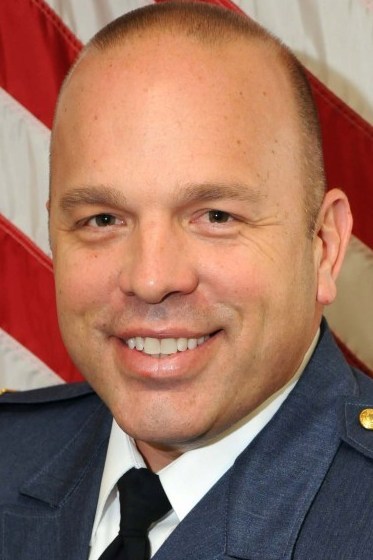
St. Paul Police Chief Todd Axtell, shown at Chris Coleman’s budget address in August, called his first 100 days on the job “an incredibly challenging time to become police chief.”
By CHAO XIONG , STAR TRIBUNE
September 28, 2016 - 7:28 PM
Two weeks into his first 100 days as St. Paul police chief, Todd Axtell was met with an unexpected firestorm as protesters took to the streets to express concern over the killing of a black man by a police officer from a nearby suburb.
After Philando Castile was fatally shot in Falcon Heights on July 6 by St. Anthony police officer Jeronimo Yanez, St. Paul became ground zero for reaction to the case. Demonstrators camped outside the governor’s residence on Summit Avenue, marched on Interstate 94, rallied outside the Ramsey County courthouse downtown, protested outside Ramsey County Attorney John Choi’s office and attempted to occupy a city park. Dozens were arrested and cited.
“It was an incredibly challenging time to become police chief,” Axtell said in an interview Tuesday before he addressed the City Council about his first 100 days in office and goals for the future. “It really changed the trajectory of the department at that time.”
Demonstrators criticized Axtell’s officers for cracking down unfairly on them and targeting key organizers. Police Federation President Dave Titus said some demonstrators were aggressive with police. The turmoil has marked Axtell’s short time as chief.
“Some believe we were too quick to act,” he said in the interview. “Some believe we didn’t act quick enough. They’re not easy decisions, but they always have to be based on what’s in the best interest of our entire community, what’s in the best interest of public safety.”
Axtell told the City Council that he wanted his officers to take actions that are “reasonable, necessary and done with respect.” The department will begin gathering more feedback from residents about their interactions with police, he told council members.
Axtell said in the interview that the department is still developing a system to gather input from both suspects and victims of crimes, in addition to the community at large, that will roll out in 2017.
In response to a question from Council President Russ Stark, Axtell said an area that could improve is transparency with the department’s data. Axtell pledged to start posting data about the department’s traffic stops by the end of the year, which will include information about race.
Axtell has said that his first priority is reducing gun violence. Under questioning by Council Member Amy Brendmoen, he revealed that shots-fired calls in the city have increased 25 percent while the number of aggravated assault gunshot victims has decreased compared to this time last year.
“There are some anomalies we are looking at right now,” said Axtell, adding that the department is analyzing how many shots-fired calls were founded vs. unfounded.
Council Member Rebecca Noecker said the department should also provide context for its data, and asked the chief about ongoing training for officers, including in the area of implicit bias. Axtell said he is committed to annual implicit bias training for his officers.
http://stpaulpolicefoundation.sbstrategies.com/wp-content/uploads/sites/55/2014/07/logo1.png00Melanie Gagehttp://stpaulpolicefoundation.sbstrategies.com/wp-content/uploads/sites/55/2014/07/logo1.pngMelanie Gage2016-09-29 14:51:202016-09-29 14:51:20St. Paul chief: First 100 days on job 'incredibly challenging time'
For Nearly a Decade Holiday Lights in the Park has been a Shining Light for Residents and Law Enforcement in St. Paul
Plans are set for the 2016 edition of St. Paul’s best and largest nightly holiday celebration
ST. PAUL, MINN. – September 29, 2016 – The Saint Paul Police Foundation announced today that Holiday Lights in the Park, the Midwest’s largest outdoor holiday light display will illuminate St. Paul’s Phalen Park for the ninth straight year. The lighted displays will shine brightly each evening from Tuesday, November 22 until January 1, 2017.
For 41 evenings Phalen Park will be lit up with a wide variety of holiday-themed displays. Visitors tour the displays in the warm confines of their vehicle, making weather a non-factor. In each of the previous year’s more than 20,000 cars have visited Holiday Lights in the Park, making it the area’s largest nightly holiday celebration.
For new St. Paul Police Chief Todd Axtell Holiday Lights in the Park is a wonderful way for his department to reach out to the community.
“An event with the track record of Holiday Lights is asset to our city,” said Axtell. “I am excited to see our officers from throughout our department interacting with visitors and residents alike. This event not only puts people in the holiday spirit, it also brings us all closer together.”
Uniformed St. Paul Police Officers will be at the entrance to Holiday Lights greeting guests and thanking them for their support. In turn the officers hope that these few moments of holiday cheer and gratitude will help to strengthen the bond that is crucial to protecting and serving a city as diverse as St. Paul. Organizers hope that the opportunity for families, and especially children, to meet officers face-to-face will create new dialogues and cultivate higher levels of trust and cooperation.
The Saint Paul Police Foundation uses the proceeds from Holiday Lights to make the St. Paul area safer for citizens and law enforcement officials.
“Holiday Lights has been a great resources not only for community outreach but to give additional support to our men and women in blue who protect and serve our city,” said Donna Swanson,Executive Director of the Saint Paul Police Foundation. “For almost a decade this event has evolved into a community celebration that gives our officers the additional resources not included in the police budget.”
Through Holiday Lights the Saint Paul Police Foundation raises funds to make the St. Paul area safer for citizens and law enforcement officials. Funds support community engagement efforts, safety equipment and department outreach. In the past eight years, Holiday Lights has raised nearly $420,000 for a variety of St. Paul and East Metro nonprofits. Since its inception in 2005, the Foundation has raised nearly $5 million to help support numerous SPPD initiatives including providing lifesaving equipment, Shop with Cops, Police Activity Leagues, Cops and Kids program and community ambassadors.
“Holiday Lights makes our city brighter, both literally and figuratively,” said Axtell. “I want to personally welcome all of our visitors who show their support each holiday season. We are so very grateful for their support and that of the Saint Paul Police Foundation.”
2016 Holiday Lights in the Park at a glance:
What: More than 60 holiday-themed light displays located on a driving path
When: From 5:00 to 10 p.m. nightly from November 22th to January 1st, 2017.
Where: Phalen Park, 1615 Phalen Drive East, in St. Paul
Who: Saint Paul Police Foundation, along with volunteers from St. Paul Police Department.
Cost: Tickets $10 dollars per vehicle nightly – and available online or at the park’s main gate.
Holiday Lights in the Park is a venture the Saint Paul Police Foundation with the sole purpose of creating a fun and affordable holiday event that raises funds to help protect the men and women who protect the residents of St. Paul. All of the net proceeds of the event will be distributed through the Saint Paul Police foundation to the St. Paul Police Department to provide enhanced safety and training to officers Holiday Lights in the Park is open nightly from November 22 to January 1, 2017 at St. Paul’s Phalen Park.
Donna Swanson, executive director Holiday Lights in the Park 651-291-2820 [email protected]
Robb Leer, media liaison Holiday Lights in the Park 612-701-0608 [email protected]
###
http://stpaulpolicefoundation.sbstrategies.com/wp-content/uploads/sites/55/2014/07/logo1.png00Melanie Gagehttp://stpaulpolicefoundation.sbstrategies.com/wp-content/uploads/sites/55/2014/07/logo1.pngMelanie Gage2016-09-29 01:42:022016-09-29 15:12:17For Nearly a Decade Holiday Lights in the Park has been a Shining Light for Residents and Law Enforcement in St. Paul
Cabela’s Package - Pat Duffy
Cragun’s Resort Package- Tianna Reges
Timberwolves Items - Diana Johnson
Cragun’s Resort Package - Ken Cleveland
Ride-a-longs 1.) Derek Gunderson 2.) Kyle Makarios
Fine Wines - Brett Greenfield
St. Paul Deluxe - Michele Jones
R F Moeller Jim Gray
Minnesota Lynx Items - Joel Henderson
Downtowner Dinner - Sam Bralo
Super America Gift Cards - David Ellis
Largely Dinner - Colleen Nelson
Join the Saint Paul Police Foundation on Friday, September 16th, 2016 for a special event at the InterContinental Saint Paul Riverfront to meet the city’s new Police Chief, Todd Axtell, and to recognize the leadership and partnerships that continue to make our community safe and strong.
Chief Todd will be joined by past chiefs and other leaders to help support the new public safety leadership transition and recognize the strong connection between the police department and the Saint Paul community.
Dress Code: Semi-Formal
Event Timeline: Doors open at 6:30 to general public with Jazz musician from 6:30 to 8:15.
General reception starts at 7:00.
The food is all you can eat
• Philly Cheesesteak Sandwiches
• Wings Station: Buffalo, Thai Peanut and Mango BBQ
• Chips and Salsa Trio
• Grilled Veg Platter
• Fresh Spring Roll
• Build your own mini donuts
• Bars
Program starts at 8:15 with band beginning at 9:15.
Parking Options:
• $8.00 Parking in Hotel Ramp
• $5.00 Parking in Capital City Plaza Ramp
• $10.00 Valet
From a picnic table in St. Paul’s Frogtown, a 21-year-old woman looked around a park. There were people of all ages eating hot dogs and hamburgers, little kids petting police horses and slightly older ones tossing a football with St. Paul officers.
“Nowadays, with people our age, it’s instilled in kids’ heads that cops are bad people,” Carter said. “So it’s good to see the children getting to see that they’re normal people.”
Safe Summer Nights events are scheduled each Thursday in St. Paul.
Todd Axtell (Courtesy photo)
The one Carter attended happened at the end of June, before long-standing tensions between communities of color and law enforcement became even more pronounced when a St. Anthony police officer fatally shot Philando Castile, who was African-American, in a Falcon Heights traffic stop.
The community’s concern over cases like Castile’s especially illustrates why Safe Summer Nights is important, said St. Paul Police Chief Todd Axtell. The idea of the weekly community cookouts in St. Paul is bringing police officers and residents together to get acquainted over a meal, rather than in times of trouble.
A REASON TO GATHER
Tom Campion approached Axtell with the idea for Safe Summer Nights in 2014.
Campion is a partner in the food wholesaler Superb Meats, based on St. Paul’s West Seventh street, and he offered to donate food and find volunteers. He thought officers could knock on doors in the areas they patrol and invite residents to the cookouts.
“It starts there — they get to have a different conversation, rather than being there with an arrest warrant or for a DWI,” Campion said. “They get to go up and say, ‘Hey, come join us for a barbecue.’ ”
And, after working in the food business for 39 years, Campion said he also knew that “no matter what color, creed or race, food is always a common denominator to get people together.”
Tang Yang and her family went to the Safe Summer Nights at Ryan Park after an officer dropped off a flyer about it at their nearby home.
“I think it’s pretty awesome to get the community to come together like this,” said Yang, who had never heard of the events before.
MORE THAN FOOD
Since its start, Safe Summer Nights has served about 35,000 meals in St. Paul, Axtell said.
And after the first successful summer, Safe Summer Nights became a nonprofit organization and received funding from the Otto Bremer Foundation, Campion said.
They’ve also held the community-police barbecues in Minneapolis, Eagan, Burnsville, Columbia Heights and elsewhere. Still, every Thursday they’re back in St. Paul at a different location each week.
The events are more than food and conversation. St. Paul Parks and Recreation sets up its 30-foot-tall climbing wall and a bouncy house. The St. Paul Fire Department has set up a display showing how to prevent kitchen fires and how to react to a grease fire. There are also police motorcycles, the bomb squad and other equipment on display.
At Ryan Park, Axtell said he talked to two young girls from the neighborhood. They told the police chief they want to become police officers.
“We want to first of all build relationships, but also have the potential to hire a more diverse work force and become more reflective of our community,” Axtell said. “These interactions, they build relationships. People become proud of our officers and then they really want to emulate that.”
IF YOU GO
Safe Summer Nights barbecues are scheduled each Thursday, 5-7 p.m., in St. Paul. The ones left for this summer are:
Thursday, Rice Street Recreation Center, 1021 Marion St.
Aug. 4, Hazel Park Recreation Center, 945 N. Hazel St.
Aug. 11, Dunning Recreation Center, 1221 Marshall Ave.
Aug. 18, Neighborhood House, 179 E. Robie St.
Aug. 25, Conway Recreation Center, 2090 Conway St.
http://stpaulpolicefoundation.sbstrategies.com/wp-content/uploads/sites/55/2014/07/logo1.png00Melanie Gagehttp://stpaulpolicefoundation.sbstrategies.com/wp-content/uploads/sites/55/2014/07/logo1.pngMelanie Gage2016-07-25 20:09:022016-07-25 20:09:02At community barbecues, kids see St. Paul cops as ‘normal people’
As protesters who shut down Interstate 94 in St. Paul held their ground before a line of police officers, St. Paul’s new police chief was working the phone.
It was just over two weeks since Todd Axtell was sworn in, but he was relying on relationships he built over 27 years moving up the ranks as a St. Paul police officer. Axtell was calling African-American community leaders, and they were phoning him.
One of them, the Rev. Darryl Spence Sr., had already talked with the group on the interstate. They were upset over the St. Anthony police shooting of Philando Castile and did not want to leave.
“Then the chief called and said, ‘Can you go down there one more time and give it a try before we have to arrest the people?’ ” Spence said. “And I said, ‘I’ll give it another try.’ ”
Axtell became police chief June 23 on the strength of his community connections. And, during the recent unrest, Mayor Chris Coleman said he saw the man he selected for the top cop job “immediately able to establish dialogue with folks that were either out protesting or folks that were concerned about what was happening.”
“He had the history, he had the relationships, and he put those into immediate practice,” Coleman said.
During Axtell’s whirlwind first month as police chief, he has also:
Overseen the response to other protests in St. Paul, from an encampment outside the Governor’s Residence to marches that closed city streets. The city has spent more than $1 million dealing with protests over Castile’s death — most of it for police personnel.
And before Castile’s death, created a community-outreach unit, one of his priorities as chief.
“I’ll tell you, he certainly got a heck of a baptism his first month on the job,” said Nathaniel Khaliq, former president of the St. Paul NAACP. “I think he provided outstanding leadership, considering the challenges that he faced.”
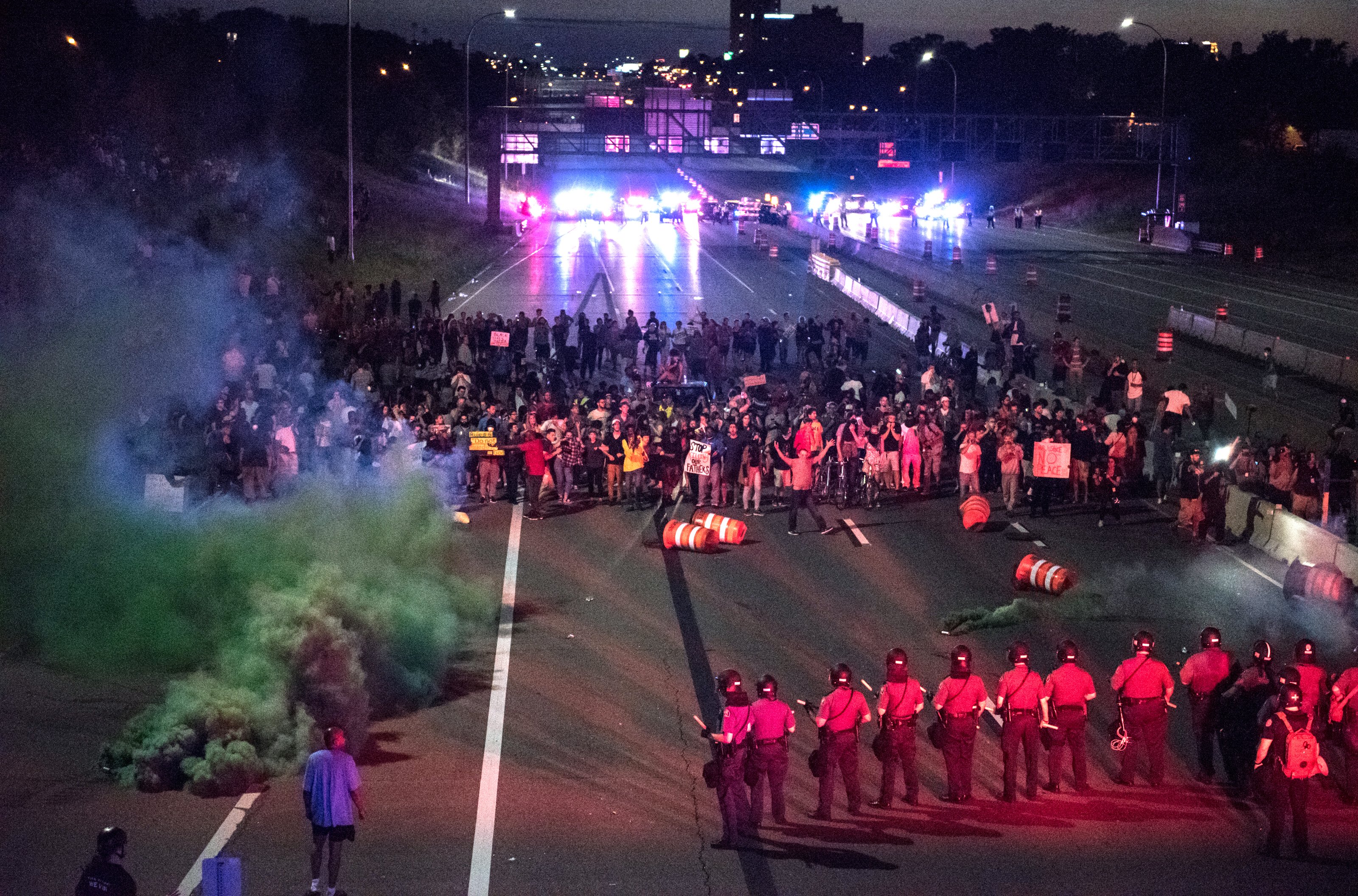
And for Axtell, the biggest challenge was the July 9 confrontation on I-94. Spence said he saw people peacefully demonstrating, but he also saw people he didn’t recognize. He pegged them as professional agitators because they were wearing gas masks. Someone threw a rock, striking Spence in the leg and cutting him, and he left. Tensions escalated.
In the end, 21 officers were injured by rocks and projectiles thrown at them. Police used smoke grenades and blast balls that produced flashes and bangs, and state troopers arrested 50 people on the highway.
Other African-American leaders in St. Paul, Coleman and the police union president agree that Axtell has risen to the occasion in the national spotlight. Yet there were those who were rankled by Axtell’s and Coleman’s description of what happened on I-94 as a “riot.”
St. Paul Police Chief Todd Axtell, center, joined by St. Paul Mayor Chris Coleman, left, and and Minnesota State Patrol Col. Matt Langer, speak about protests July 9. On the table in front of them were rocks and rebar that they said were thrown at officers. (Pioneer Press: Mara H. Gottfried)
Police chiefs often walk a tight-rope between appeasing the public and rank-and-file officers, but Axtell said he does not make statements based on what he thinks people want to hear.
“I base what I say on what I believe at the time I say it,” Axtell said this past week while reflecting on his first month on the job. “When our officers come under attack, you can guarantee I will come out with some strong statements in support of our public servants, and I will never apologize for that.
“It’s also important that I come out and continue to build strong relationships with all of our diverse communities in St. Paul and make sure that they have a voice at the St. Paul police department.”
FIVE BLOCKS AWAY
Axtell often talks about making “deposits into the bank of trust.” He explains: “It’s not a matter of if something controversial happens, but when. And when those controversies happen, you must have a full bank of trust with our diverse communities.”
On Axtell’s 14th day as police chief, it happened — just not in St. Paul. It was about five blocks away, in Falcon Heights, where a St. Anthony police officer shot Castile during a traffic stop.
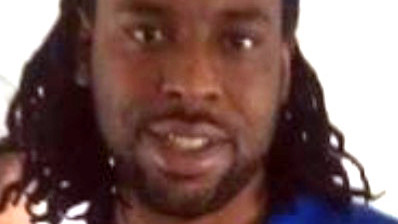
Philando Castile (Courtesy photo)
The case drew instant national attention as Castile’s girlfriend live-streamed the aftermath of the shooting on Facebook.
Tyrone Terrill, president of the African American Leadership Council, said he was horrified by the video. He knew protests would follow.
“You couldn’t help but be angry as a community when you see what happened,” Terrill said.
But he did not expect the protests would be so focused on St. Paul. “I think Falcon Heights has gotten a pass, St. Anthony village has gotten a pass and that’s unfortunate,” Terrill said. “It’s all been St. Paul, St. Paul, St. Paul, and they’re not the police department responsible for his death.”
WALKING THE TIGHT ROPE
Within hours of Castile’s death, protesters set up outside the Governor’s Residence. St. Paul opened its Emergency Operations Center — used to coordinate multi-agency responses to anything from protests to a major storm to a presidential visit.
Axtell divided his time between the center, where he monitored all the police operations, and going into the field “to thank our officers, check on how they’re doing and stop at the various protest locations,” Axtell said.
There was little time for sleep. And no time to finish unpacking his office.
“I haven’t felt this level of constant stress in my career,” Axtell said. “But I find that it motivates me to do more.”
He was driven by a concern for his officers and for the city as a whole. He relies on his mantra that communication can help build relationships and move forward.
Dave Titus, St. Paul Police Federation president, said he watched as Axtell “rose to the occasion and supported his troops and represented the department well.”
“It was a very serious test, and I hope it’s an indication of how he will proceed,” Titus said.
WEIGHING IN ON THE RESPONSE
St. Paul police have grown accustomed to handling protests: Black Lives Matter has held peaceful, permit-less marches in the city since 2015. Demonstration have blocked traffic and transit and targeted major events like the State Fair and the Twin Cities Marathon.
After Castile’s death, the only aspect that caught St. Paul police off-guard was the violence that broke out during the July 9 shutdown of I-94, Axtell said. The next day, he and Coleman described the scene as a riot.
Erin Pavlica, who lives in St. Paul’s Hamline-Midway area, was disappointed by that characterization.
Police shoot smoke rounds after telling protesters to move off Interstate 94 near the eastbound Dale Street exit in St. Paul July 9. Traffic on the interstate was closed in both directions by a large group protesting the police shooting of Philando Castile. (Pioneer Press: Andy Rathbun)
“I felt like I was watching a different protest than they were. I did not see a riot,” said Pavlica, who watched a live stream of what was happening. She knows Castile’s uncle, so his death hit close to home.
Pavlica, who met Axtell when he was in charge of the police district where she lives, has always respected him. She is still looking forward to what he will do as chief.
“This was a very, very tough situation for him, but a lot of times this is how you see the true light or leadership of people, when they are put under pressure,” she said.
Law enforcement arrested 102 people between the highway and a march at Grand Avenue and Dale Street a few hours later. Prosecutors charged people arrested on the highway with third-degree riot.
Jordan Kushner, an attorney representing people who were charged, described the police response on the highway as excessive.
“They trapped the people on the highway and let the situation escalate with the people on the outside throwing objects,” he said. “And then they blamed the nonviolent peaceful protesters by charging them with riot when they had nothing to do with any sort of violence.”
But Axtell said police “gave multiple opportunities for everyone on the freeway to exit onto the Dale Street ramp.” He said his officers used “incredible restraint under a very dangerous and violent attack.”
Several leaders in the African-American community said they also regarded the St. Paul police response on the highway as restrained.
“To have firecrackers and rebar coming at officers and not even use tear gas?” Terrill said. “I doubt there are very many departments in America that would have done that.”
RAISING THEIR GUARD
The day after Castile was killed, Axtell ordered St. Paul officers to pair up. That evening, a sniper killed five officers working a protest march in Dallas. The suspect told authorities he was upset about the killings of Castile and Alton Sterling on July 5 in Baton Rouge, La. Then, on July 17, three officers were fatally shot in Baton Rouge.
People have left comments on the St. Paul police department’s Facebook page, such as, “What happened in Dallas should have happened in your city.” There hasn’t been a specific threat, though, Axtell said.
“I always err on the side of safety when we make those decisions,” Axtell said. He doesn’t know how long he’ll continue requiring two-person squads.
For the six days after Castile was killed, Axtell also implemented a schedule not used in St. Paul since the city hosted the Republican National Convention in 2008. Patrol officers worked 12 hours on, 12 hours off. The schedule increases the number of officers available to respond to regular calls and to protests.
Officers got little rest at that time, said Titus. He said they still feel demoralized by a negative climate toward law enforcement and need to be “hypervigilant” against possible threats, which is draining.
But there have also been moments that have bolstered Axtell’s and the officers’ spirits.
“I hear so many stories about officers not even being able to buy their meals when they go out because people are lining up, wanting to buy their food and thank them,” Axtell said.
SETTLING IN TO THE JOB
Before he got the job, Axtell set his priorities — reducing gun violence, diversifying the ranks and starting a community-engagement unit. He said he has started work on all of them, though not as much in the first month as expected.
He also has to contend with keeping his department within its nearly $110 million budget. Axtell said he is hoping the city will be able to get state or federal funding to cover rising protest costs, so he won’t have to make cuts.
And the protests continue.
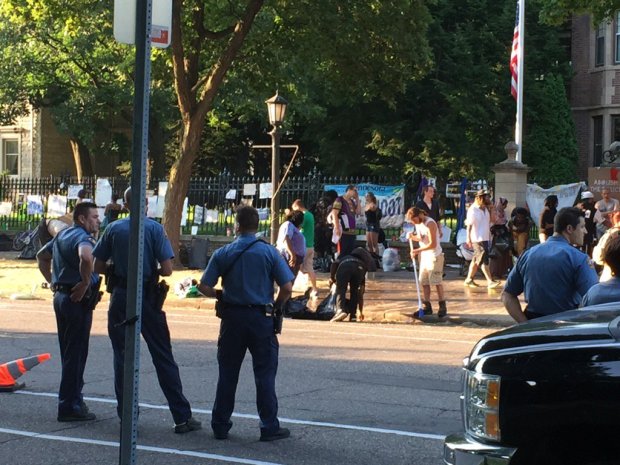
St. Paul police watch over the clearing of a protest encampment on July 18 in front of the Governor’s Residence in St. Paul. (Pioneer Press: Mary E. Divine)
The encampment outside the Governor’s Residence remains, with protesters saying they have no plans to leave. St. Paul police reopened the section of Summit Avenue in front of the mansion and closed its Emergency Operations Center on Monday.
Protesters outside the mansion have been upset about restrictions police have put on their encampment. But organizer Curtis Avent said he and Axtell have had productive conversations when the chief has come to talk with demonstrators.
“So far, he’s been a man of integrity in dealing with me and negotiating situations,” said Avent, of St. Paul. “I would be glad to see police-community relations improve and, if he’s the man to do that, then he’s who we want to work with to see it done.”
http://stpaulpolicefoundation.sbstrategies.com/wp-content/uploads/sites/55/2014/07/logo1.png00Melanie Gagehttp://stpaulpolicefoundation.sbstrategies.com/wp-content/uploads/sites/55/2014/07/logo1.pngMelanie Gage2016-07-25 19:50:262016-07-25 19:51:07Philando Castile protests: A baptism by fire for St. Paul’s new police chief
Join the Saint Paul Police Foundation on Friday, September 16th, 2016 for a special event at the InterContinental Saint Paul Riverfront to meet the city’s new Police Chief, Todd Axtell, and to recognize the leadership and partnerships that continue to make our community safe and strong.
Chief Todd will be joined by past chiefs and other leaders to help support the new public safety leadership transition and recognize the strong connection between the police department and the Saint Paul community.
In the wake of a national mass shooting, newly picked police chief Todd Axtell spoke of community outreach and engagement with all the people of St. Paul — but noted his department was ready to handle a similar tragedy should the need arise.
Axtell, 48, the city’s current assistant police chief for operations and has 26.5 years with the department, was chosen Monday by Mayor Chris Coleman over four other finalists.
“He has built tremendous relationships in the community, and he has incredible compassion,” Coleman said.
Axtell said he was “profoundly honored to have the opportunity to serve as St. Paul’s next police chief, especially when I consider the exceptional chiefs who have preceded me. …
“My philosophy is pretty simple: Get to know people before something happens. … I am a big believer in making a lot of deposits into the bank of trust.”
The Rev. Charles Gill, president of the St. Paul Black Ministerial Alliance who sat on the committee reviewing applicants for the job, said Axtell stood out as someone who had built an entire career on community engagement, regardless of race or religion.
“It went all the way back, all the way across the board. It wasn’t something he just put together for this process,” Gill said.
Gill was called upon by Coleman to start Monday’s press conference by assembling some local religious leaders — reverends and imams both — to pointedly call Islam a religion of peace. The announcement took place a day after a mass shooting Sunday in Orlando in which a man who had invoked the Islamic State in conversations with authorities killed 49 people.
Reflecting on the shooting, Axtell said, “It’s tragic; it unfortunately is our reality that law enforcement is faced with in America today.
“Last month, 300 St. Paul officers and 150 St. Paul firefighters went through mass-casualty training, including active-shooter training. I’m very confident that St. Paul is well prepared to handle any incident similar to Orlando that happens in our city.”
But, Axtell added, “you have to have prevention, intervention and enforcement. They have to go hand in hand.”
Axtell started as a patrolman in St. Paul’s eastern district in 1989, was promoted to sergeant in 1998 and quickly rose through the ranks.
Though he has lived the city’s Highland Park neighborhood for the past six years, he grew up in rural Northfield, Silver Bay and Brainerd, and previously lived in St. Paul’s Frogtown neighborhood. He was the only applicant who lives in St. Paul.
Sayfuddin Mohamud, 5, listens at the base of the podium as new St. Paul Police Chief Todd Axtell speaks during a new conference in St. Paul on Monday, June 13, 2016. Sayfuddin is the son of Imam Dr. Hassan Mohamud, behind Axtell. St. Paul Mayor Chris Coleman named Axtell as the news police chief Monday. The city council will vote on whether to confirm Axtell as chief on June 22. If approved, he would start in his new position the following day.
Since 2013, as assistant chief for operations, Axtell oversaw all uniform operations, covering 450 personnel from beat patrol officers to SWAT and mobile field forces to parking enforcement.
If approved as chief by the city council, he would manage the department’s budget of nearly $110 million, and oversee its more than 700 employees.
He also will face numerous challenges, including leading the department at a time of increased scrutiny over police use of force, particularly in communities of color; combating gun violence; keeping up staffing as the city grows; and implementing a body-camera policy next year.
Axtell said that as assistant chief, he’s been taking a more critical look at use of force — noting community complaints about use of force declined more than 62 percent in 2014-2015 compared with 2012-2013 — and will continue that work as chief.
In addition to building community trust, a goal every chief candidate emphasized, Axtell said he would focus on two other things as chief: further diversifying the department and reducing gun violence.
Axtell noted during the press conference that the police department has a 19 percent diversity rate, compared with 44 percent for the city.
St. Paul city council president Russ Stark predicted Axtell’s confirmation would be an easy one. Four of the city’s seven council members — including Stark, Dai Thao, Dan Bostrom, and Chris Tolbert — stood behind Axtell during Monday’s press conference.
The city council will vote June 22 on whether to confirm Axtell as chief. If approved, he would start in his new position the following day.
City officials said Axtell’s salary has yet to be negotiated, though it would range from $117,000 to $160,000. He earns $135,241 as assistant chief; outgoing police chief Tom Smith made $156,769.
Axtell said he became interested in becoming a police officer at a young age because of his grandfather, an officer in Silver Bay, Minn. He died of a heart attack while mowing his lawn when Axtell was 2 years old.
“I didn’t have the opportunity to get to know him, but I always was intrigued by the fact that he was a police officer,” Axtell said.
Axtell spent the first eight years of his life in Northfield and the next eight years in Silver Bay until Reserve Mining shut down in 1984. His father had been a draftsman at Reserve Mining; his mother was a hairstylist.
“Our home overnight went from being valued at $54,000 to $15,000 the next week, so it was devastating for our family, but my parents are very resilient,” Axtell said. They found new jobs in Brainerd.
Axtell was 16 years old when they moved.
“I was a little disappointed with having to move, but in hindsight it was probably the best thing that ever happened to me,” Axtell said. He was in school and got a job as an usher for Mann Theaters. Axtell came to know Marvin Mann, the longtime head of the theater company. He said he remains good friends with Mann’s sons, who now own Mann Theaters.
“I am a big believer in making a lot of deposits into the bank of trust.” Axtell went to Alexandria Technical College, earned his two-year law enforcement degree and quickly went to work as an officer in Breezy Points/Pequot Lakes, Minn.
“Funny little story about how I got my job there,” said Axtell, who described driving through Pequot Lakes and seeing a squad car parked outside a restaurant. “I stopped in and I saw a younger officer, he was 23 or 24 at the time. I introduced myself and said, ‘I’m looking for a police job.’ I asked him who the chief was and he looked at me and said, ‘You’re looking at him.’ … He hired me at that very moment.”
He worked in the area for a year and half before applying for St. Paul.
“I quickly found out after becoming a police officer that my ultimate goal should have been becoming a St. Paul police officer because it had the best reputation … certainly in the state of Minnesota,” Axtell said.
Axtell has a master’s degree in police leadership, administration and education from the University of St. Thomas. He is also on the St. Paul YWCA’s board of directors, where he serves as co-chair of youth development.
For years, Axtell served as a mentor with 180 Degrees, an at-risk youth program; on the board of Breaking Free, which helps survivors of prostitution and sex trafficking; and on the boards of other St. Paul civic organizations. Axtell also works with the city’s junior police academy to build relationships between young people and officers. Roughly 95 percent of the 500-strong class to graduate this summer are people of color.
Axtell beat out four other finalists for the job, including St. Paul police Cmdr. Colleen Luna, Senior Cmdr. Tina McNamara, interim Assistant Chief Matt Toupal and Minneapolis Police Lt. Eddie Frizell. Axtell was also a finalist to become St. Paul chief in 2010.
The Saint Paul Police Foundation is appreciative of the generous grant from Otto-Bremer Trust. The Foundation’s work is to preserve and support public safety by marshaling community resources to strengthen the bond between the people of Saint Paul and their police department. With these additional resources the Foundation will be able to further enhance the public-safety and community relations activities of the Department ensuring the Department is an integral part of the fabric of our great community.
St. Paul police will use a new half-million-dollar grant to continue and expand community outreach programs.
The $500,0000, two-year grant from the Otto Bremer Trust was awarded to the St. Paul Police Foundation, a nonprofit that supports the department’s work. Half was released last week to the foundation, which has agreed to raise a matching $250,000 in order to receive the other half.
“In my almost 27 years at the St. Paul Police Department, this is the most significant grant for community outreach,” said Assistant Chief Todd Axtell, who helped secure the funding. “Anybody that’s been following national events understands that building trust between the community and police has to be our top priority.”
The department has to apply for the money from the foundation for specific projects, which include programs with the St. Paul Public Schools, St. Paul Parks and Recreation and YWCA of St. Paul, among others.
“We are pleased to provide funding for the critical and important work the Foundation is doing in partnership with the St. Paul Police Department,” Otto Bremer Trust co-CEO and trustee Daniel C. Reardon said in a written statement.
Axtell said he and Reardon began discussing the grant about six months ago. The department has “always struggled” to find enough money to fund outreach programs, Axtell said, while balancing other needs within its budget.
The grant will help the department achieve key goals in outreach to youth from childhood through the early 20s, Axtell said, including: drawing young people into law enforcement work with an emphasis on diversifying St. Paul police’s rank and file, breaking down barriers between officers and youth of color, and helping officers see youth through “a new lens.”
The money will help save the department’s YWCA Junior Police Academy, which was headed toward an uncertain future this year — its 10th anniversary — because of a lack of money. Since its inception, the program has served about 500 youths, 95 percent of them people of color.
It will also help fund things as simple as new basketballs for regular games between St. Paul police and Somali youth and activities such as hockey, fishing and soccer.
“This is all about keeping kids out of the criminal justice system,” Axtell said.
Chao Xiong • 612-270-4708
Twitter: @ChaoStrib
By CHAO XIONG , STAR TRIBUNE May 05, 2016 - 9:22 PM
http://stpaulpolicefoundation.sbstrategies.com/wp-content/uploads/sites/55/2014/08/Screen-shot-2016-04-25-at-8.46.22-AM.png302822Melanie Gagehttp://stpaulpolicefoundation.sbstrategies.com/wp-content/uploads/sites/55/2014/07/logo1.pngMelanie Gage2016-05-06 17:31:452016-05-06 17:35:05$500,000 Grant Will Fund St. Paul Police Community Outreach